MORTGAGE EDUCATION
Demystifying Cash to Close
Exactly How Much Money Do You Need on Closing Day?
Your down payment is just one part of closing day costs. Cash to close includes four key components: your down payment, lender fees, prepaid items like property taxes and homeowner’s insurance, and escrow or reserve funds required by your lender. Understanding each piece helps you avoid surprises at signing.
Let’s break it down:
- Down Payment: This is your upfront contribution toward the home purchase price.
- Lender Fees: These cover loan origination, application, and underwriting—basically the cost to get your mortgage approved.
- Prepaid Items: These are advance payments on property taxes, homeowner’s insurance, and sometimes interest accrued before your first mortgage payment.
- Escrow/Reserves: Funds held by the lender to cover future payments like taxes and insurance, or extra reserves for loan security.
For example, if your home price is $300,000 with a 5% down payment ($15,000), lender fees of $3,000, prepaid property taxes and insurance totaling $2,500, and escrow reserves of $1,500, your total cash to close would be $22,000.
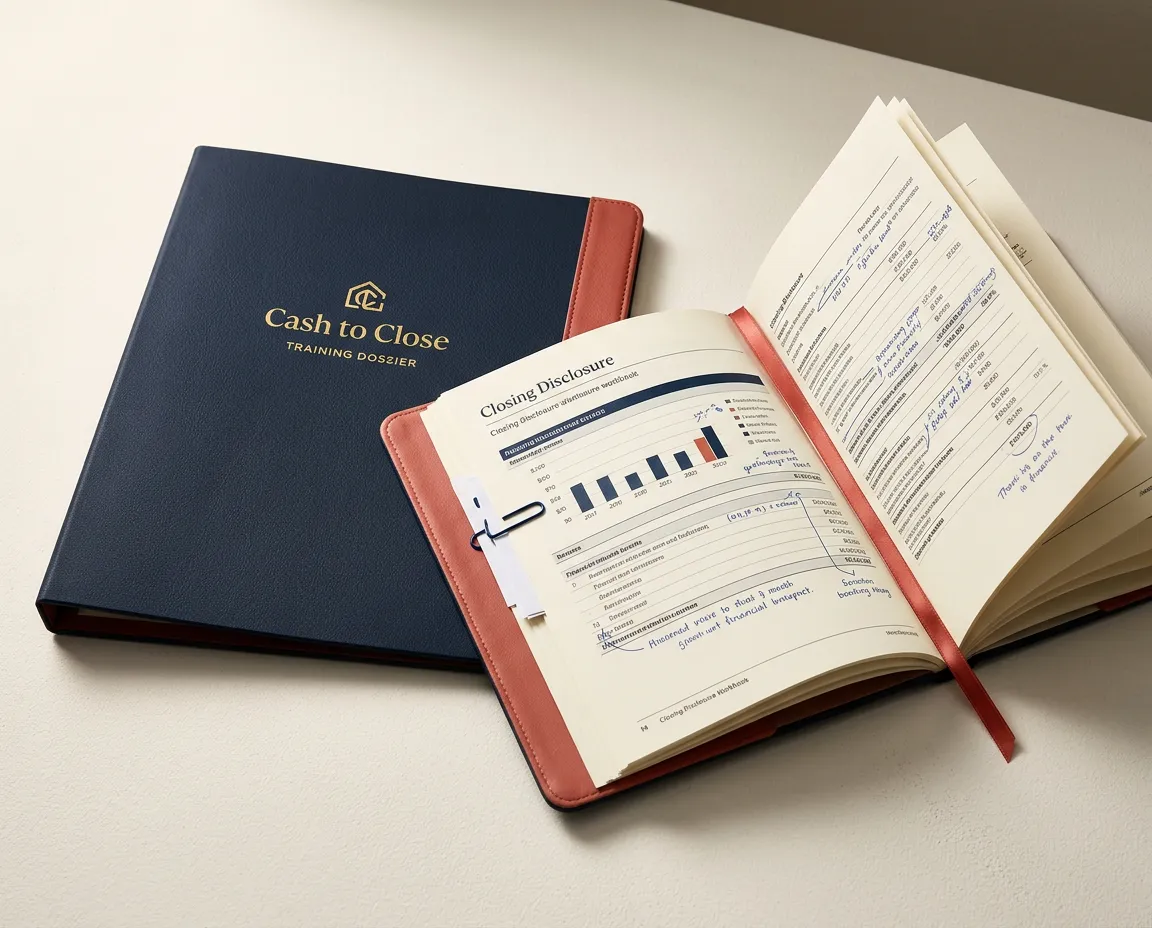
Two important documents help clarify these amounts: the Loan Estimate, which you receive early and outlines expected costs, and the Closing Disclosure, which provides a final, detailed summary right before closing day. Comparing these helps you prepare.
Pro tips: Always review these docs carefully and ask your lender about any unfamiliar fees. Planning ahead means no surprises and a smoother closing.
Our free Cash-to-Close Checklist guides you step-by-step through these details so you can close with confidence.
Instant PDF Download · No SSN Required · Fully Updated for 2026 Closing Costs and Guidelines

TRANSPARENT CLOSING MATH: UNDERSTANDING YOUR CASH TO CLOSE
The 4 Key Components of Your Cash to Close — Explained with Examples
Knowing exactly what makes up your final settlement figure helps you plan confidently and avoid surprises. Here’s a detailed look at how your total cash to close is calculated before you get your keys, plus practical tips and a clear example.
1. Down Payment
This is your upfront equity stake in the home—the amount you pay directly toward the purchase price. It lowers the total mortgage amount and builds your ownership from day one.
- Typically ranges from 3% to 20%+ depending on your loan program
- Creates instant equity as soon as you close
- Reduces the principal you finance and future interest payments
- Pro-tip: Save for a larger down payment to lower monthly payments and improve loan terms
2. Closing Costs
Plan for about 2% to 5% of your loan amount to cover all fees involved in processing and finalizing your transaction.
These include lender charges as well as third-party services necessary to complete your home purchase.
- Lender fees: loan origination, underwriting, and processing
- Third-party costs: appraisal, home inspection, and surveys
- Title insurance and legal settlement charges
- Government fees: recording, transfer taxes, and stamps
- Pro-tip: Review your Loan Estimate and Closing Disclosure carefully to compare these costs and confirm they match
3. Pre-Paids & Escrow
These are upfront funds collected to set up your escrow account, which handles ongoing expenses like property taxes and insurance automatically, giving you peace of mind.
- First year’s homeowners insurance premium
- Prepaid interest—from closing day through the end of the month
- Buffer amounts for property tax and insurance escrow accounts
- Pro-tip: Escrow amounts vary by location and lender, so check your documents to know the exact figures
4. Earnest Money Credit
Your earnest money deposit is the “good faith” payment made when your offer was accepted. This amount is credited back to you at closing, reducing the cash you need to bring.
- Usually paid to the escrow attorney or title company upfront
- Applied as a dollar-for-dollar credit toward your total closing amount
- Directly lowers the final wiring amount on closing day
- Pro-tip: Keep your earnest money receipt handy to verify this credit at settlement
Example: For a $300,000 home with a 5% down payment ($15,000), estimated closing costs of 3% ($9,000), prepaid escrow of $3,000, and $5,000 earnest money, your cash to close would be approximately $22,000. This breaks down as:
- Down Payment: $15,000
- Closing Costs: $9,000
- Pre-Paids & Escrow: $3,000
- Minus Earnest Money Credit: -$5,000
This simplified example illustrates why understanding each piece matters.
Before closing, you'll receive two key documents: the Loan Estimate (early in the process) outlines estimated costs; the Closing Disclosure (a few days before closing) provides the final, detailed statement. Always compare these carefully and ask questions to avoid surprises.
Want a tailor-made breakdown for your situation? Hit the button below to get started!
TRANSPARENT CLOSING MATH
Example: Step-by-Step Cash to Close Calculation
Let's break down each component—the down payment, closing costs, pre-paids, and earnest money deposit—to see exactly how they add up to your final cash to close. We’ll also explain the important roles of the Loan Estimate and Closing Disclosure, and share tips to help you prepare smoothly.
The Scenario
Imagine you’re purchasing a primary residence using a conventional fixed-rate loan—a common homebuyer's path.
PURCHASE PRICE
$400,000
DOWN PAYMENT PERCENTAGE
5%
The loan amount you’ll finance is $380,000, which is 95% of the purchase price—you’ll cover the rest with your down payment.
Pro-Tip: Your Loan Estimate provides your closing cost estimate early on, while the Closing Disclosure, delivered 3 days before your signing, confirms the final numbers. Review both carefully and ask your lender to explain any surprises.
Example Breakdown: For a $400,000 home with a 5% down payment, you’ll pay approximately $20,000 down, plus $9,500 in closing costs, and about $3,500 in prepaid items and escrow setup. After subtracting your $4,000 earnest money deposit, the estimated cash you’ll bring to closing is $29,000.
TRANSPARENT CLOSING ROADMAP
Let’s break down the confusing parts of Cash to Close, making sure you understand every penny needed on closing day. This guide walks you through the four key components with simple explanations, a clear example, and helpful tips so you feel confident and prepared.
Avoid Closing Day Surprises
Knowing what to expect can save you stress and money. We’ll clarify the four parts forming your Cash to Close total, explain how the Loan Estimate and Closing Disclosure documents help you track these costs, and share pro-tips to handle common challenges.
Understanding two vital mortgage disclosures guarantees you arrive at the closing table with zero unexpected fees and complete financial clarity. These documents outline your loan terms and final costs so you can plan your funds confidently.
Let’s demystify the four main components contributing to your Cash to Close total: down payment, closing costs, prepaid items, and escrow deposits.
Loan Estimate (LE)
The Loan Estimate is your first detailed look at your mortgage finances. In this three-page document, you’ll see the loan terms, estimated monthly payments, and anticipated fees before you commit, helping you plan your budget early.
The initial three-page breakdown outlining the terms, monthly payments, and anticipated fees you can expect before locking in your financing. It’s delivered within 3 business days of your application and provides an estimate of the total Cash to Close at that stage.
Use this to prepare and compare your options before moving forward.
- Delivered within 3 business days of applying
- Shows your detailed closing-cost estimate along with your loan terms
- Establishes your initial baseline loan terms and estimated budget needs
- Helps you plan and avoid surprises by previewing expected payments and fees
Closing Disclosure (CD)
The Closing Disclosure is your final detailed statement showing the exact costs and amounts due at closing. It confirms or updates the estimates from your Loan Estimate, providing the precise breakdown you’ll pay on closing day.
Your final five-page legal summary delivered before signing, verifying every finalized lender cost, third-party expense, and required deposit. It arrives at least 3 business days before closing, giving you time to review and ensure everything matches your expectations.
Double-check page 1 to find your exact, final Cash to Close amount.
- Delivered at least 3 business days before closing
- Check page 1 for your exact, final Cash to Close amount
- Compare side-by-side with your Loan Estimate to spot any changes
- Review carefully and ask your lender about discrepancies
Practical Tip: Keep both documents handy and track their numbers. If things change, your lender must explain why, helping you avoid surprises.
Worked Example: Imagine your Loan Estimate shows $10,000 Cash to Close, made up of $5,000 down payment, $3,000 closing costs, $1,000 prepaid interests and taxes, and $1,000 escrow deposits. The Closing Disclosure arrives showing a $9,800 total due because some fees were lower or credits applied — always check these details to confirm.
Understanding Closing Day and Your Cash to Close
Clear Answers on
Cash to Close
Final settlement should never come with last-minute surprises. Understand the four key components of cash to close—down payment, closing costs, prepaid items, and escrow reserves—so you can confidently review how your funds are calculated, secured, and transferred. We’ll also explain how your Loan Estimate and Closing Disclosure work to keep you informed every step of the way.
For example, if your home price is $300,000 with a 5% down payment of $15,000, closing costs around $6,000, prepaid taxes and insurance of $3,000, and an escrow reserve of $2,000, your total cash to close would be approximately $26,000. Knowing these categories helps you prepare thoroughly for settlement day.
Pro tip: Always compare your Loan Estimate (provided early in your process) with your Closing Disclosure (sent three days before closing) to catch any changes in fees or required payments.
What is the difference between closing costs and pre-paids?
Closing costs are one-time fees paid to lenders and third parties for originating and finalizing your loan, such as title insurance and appraisal fees. Pre-paids are advance payments deposited into escrow to cover upcoming expenses like homeowner's insurance premiums and property taxes that become due soon after closing.
Understanding this distinction will help you anticipate the types of payments included in your cash to close.
Can seller concessions reduce my cash to close?
Yes. Seller concessions can directly offset eligible closing costs and pre-paids within your loan program limits, lowering your cash needed at closing. However, these concessions cannot be applied toward your required down payment, which must come from your own funds or approved sources.
Pro tip: Always review your Loan Estimate to see if seller concessions are correctly applied and ask your advisor if you’re unsure.
Can I use gift funds toward cash to close?
Yes, most conventional and government-backed programs accept gift funds from verified family members. To qualify, the gift must be documented with a signed gift letter and a clear paper trail proving that repayment is not expected.
This can help reduce your out-of-pocket cash to close, especially for your down payment or closing costs.
When do I get my final cash to close number?
You’ll receive an initial estimate on your Loan Estimate early in the process and a more detailed Closing Disclosure at least three business days before signing. Your settlement or title agent will confirm the exact wire amount 24 to 48 hours prior to closing, once all local fees and taxes are finalized.
Pro tip: Plan ahead by arranging your funds early to avoid delays on closing day.
Can I bring a personal check to settlement?
Generally, no. Settlement companies require verified, secure funds to comply with regulations. Personal checks for large cash-to-close amounts are not accepted. You’ll need to provide an electronic wire transfer or a certified bank cashier’s check instead.
Pro tip: Confirm the approved payment methods with your settlement agent well before closing.
How do I avoid wire fraud?
Always stay vigilant about wiring funds. Never send money based solely on email instructions. Always verify wiring details by calling a trusted contact number directly associated with your title or settlement officer. Avoid relying on phone numbers or instructions included within emails, which can be spoofed or altered.
Pro tip: Confirm wiring instructions in person or via known phone numbers before initiating any transfer.
FREE RESOURCES FOR CLOSING MASTERY
Want to feel 100% confident
on closing day? Let's break down the cash you'll need.
Access our comprehensive closing preparation toolkit. It includes concise video lessons explaining the 4 key components of Cash to Close—down payment, closing costs, prepaid items, and escrow reserves—plus a detailed worked example showing exactly how these add up. Learn to navigate your Loan Estimate and Closing Disclosure forms with confidence and discover expert pro-tips to avoid surprises and save money before wire day.
100% educational • No obligation • Expert lender guidance to empower your closing journey

Ron Cardozo
Senior Home Loan Advisor
Personal guidance for your home financing goals with dedicated mortgage solutions. We also offer in-depth education on understanding cash to close, breaking down each component clearly so you know what to expect at your closing table.
Get In Touch
Direct: (913) 710-5626
Office: (913) 710-5600
Fax: (913) 710-5699
Email: [email protected]
Address: 6201 College Blvd., Suite 100, Overland Park, KS 66211
Let’s Connect
Ready to discuss your loan options or have questions about refinancing? Contact Ron directly today. Plus, ask about our exclusive resources on mastering the four key parts of cash to close, including a simple step-by-step example that demystifies the numbers.
Prefer writing? Email Ron to get practical tips on reviewing your Loan Estimate and Closing Disclosure, and learn how to spot savings opportunities before closing day.
Mortgage Lending Disclosures: Ron Cardozo (NMLS ID: 34541) is a Senior Home Loan Advisor at First Bank (NMLS ID: 551928). All loans are subject to credit approval, underwriting guidelines, and collateral verification. Programs, rates, terms, and conditions are subject to change without notice. This is not a commitment to lend.
Equal Housing Lender | Member FDIC
© October 10th 2026 - First Bank. All Rights Reserved. | Privacy Policy | Terms of Service