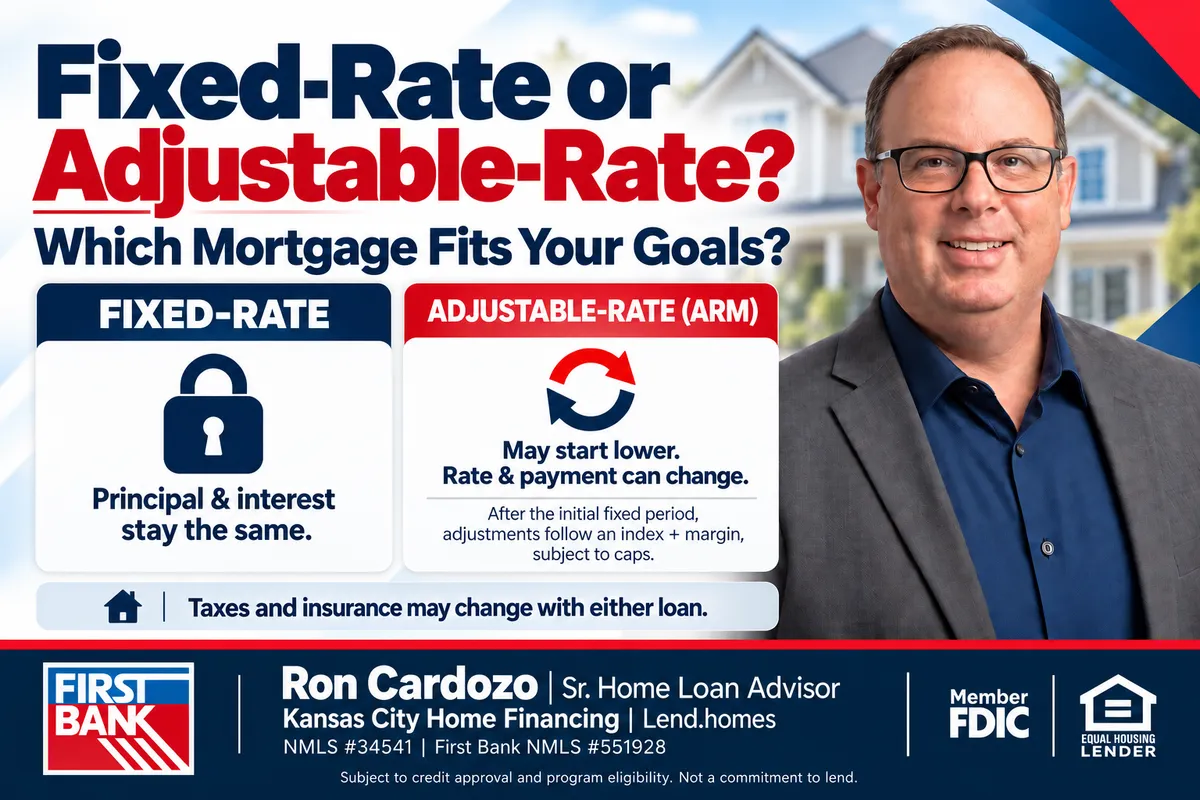
Fixed-Rate or Adjustable-Rate Mortgage: Which Is Right for You?

By Ron Cardozo, Sr. Home Loan Advisor, First Bank Mortgage | Overland Park, KS
One of the biggest choices you'll make with your mortgage isn't the loan program. It's whether your rate stays the same or can change.
A fixed-rate mortgage keeps your principal and interest payment the same for the entire loan. An adjustable-rate mortgage (ARM) may start with a lower rate, but that rate can change later, which means your payment can go up or down.
Neither one is always better. The right choice depends on how long you plan to keep the home, how much payment flexibility your budget has, and how comfortable you are with change. If you're considering an ARM, you need to know exactly how and when it adjusts.
Fixed-Rate vs. ARM at a Glance
| Fixed-rate mortgage | Adjustable-rate mortgage (ARM) | |
|---|---|---|
| Interest rate | Set when you take out the loan; never changes | Fixed for an initial period, then adjusts on a schedule |
| Principal and interest payment | Stays the same for the life of the loan | Can go up or down after the initial period |
| Starting rate | Often higher than an ARM's initial rate | Often starts lower than a fixed rate |
| Total interest cost | Known up front | Unknown, because future rates are unknown |
| Biggest advantage | Predictability and peace of mind | Lower starting payment for a set number of years |
| Biggest risk | Paying for stability you may not need if you move soon | Higher payments later if rates rise |
Keep in mind: even with a fixed rate, your total monthly payment can still change if your property taxes, homeowners insurance or mortgage insurance change.
How an ARM Adjusts
An ARM has a few moving parts. According to the CFPB, here's what to understand:
- The initial fixed period. Your starting rate lasts for a set time. In a name like "5/6 ARM" or "7/1 ARM," the first number is how many years the starting rate lasts, and the second tells you how often it can change after that (every 6 months or every year).
- The index. A market interest rate that moves with the economy. After the fixed period ends, your rate follows it.
- The margin. A set number of percentage points your lender adds to the index. It's written into your loan and doesn't change after closing.
- Your new rate = index + margin, limited by your caps (CFPB).
- Rate caps. Limits on how much your rate can change: at the first adjustment, at each adjustment after that, and over the life of the loan (CFPB).
Important: even if market rates don't change, your rate can still go up when the fixed period ends if your starting rate was lower than the index plus margin. And not every ARM adjusts downward when rates fall.
Advance notice: your loan servicer must notify you before your first rate adjustment, so you have time to budget or explore refinancing.
Your Loan Estimate includes an Adjustable Interest Rate (AIR) table showing your index, margin, caps, and the minimum and maximum rates your loan could ever reach. I'll walk you through it line by line.
Which One Fits You?
A fixed rate may be the better fit if you:
- Plan to stay in the home for many years
- Want a predictable principal and interest payment
- Have a budget without much room for payment increases
- Prefer not to worry about the direction of interest rates
An ARM may be worth considering if you:
- Expect to sell or move before the initial fixed period ends
- Expect your income to grow and can handle a higher payment later
- Are buying a higher-priced home, second home or using a portfolio loan where ARM options can be competitive
- Understand the caps and could comfortably afford the payment at the maximum rate
A word of caution: some people choose an ARM planning to refinance before it adjusts. That can work, but it isn't guaranteed. Rates, home values and your finances could all be different when the time comes.
Questions to Ask Before Choosing an ARM
- How long is the initial fixed period?
- How often can the rate change after that?
- Which index is used, and what is the margin?
- What are the caps at the first adjustment, each adjustment after that, and over the life of the loan?
- What's the highest my rate and payment could ever be? Could I afford that?
- Can the rate go down, and is there a floor?
- Is there a prepayment penalty if I sell or refinance?
If you can't comfortably answer question 5, a fixed rate is probably the safer choice.
Frequently Asked Questions
Does a fixed-rate loan mean my payment will never change?
Your principal and interest stay the same. But your total payment can still change if your property taxes, insurance or mortgage insurance change.
Will an ARM always save me money?
No. An ARM can save money during the initial period, but if rates rise after that, it could cost more over time than a fixed rate.
What does "5/6 ARM" mean?
The rate stays the same for the first 5 years, then can adjust every 6 months after that.
Can I refinance out of an ARM later?
Often, yes. But refinancing depends on future rates, your home's value, your credit and your income at that time, so it shouldn't be your only plan.
Are ARMs risky?
Today's ARMs have caps that limit how much the rate can change, which helps. The real question is whether you could comfortably afford the payment at the maximum rate your loan allows.
Let's Compare Your Options
I'll show you fixed-rate and ARM options side by side, including what an ARM could look like at its first adjustment and at its maximum rate, so you can choose with your eyes open.
Not sure whether fixed or adjustable is right for you? Call or text me.

Ron Cardozo | Sr. Home Loan Advisor
Call/Text: 913-710-5626
Email: [email protected]
Web: www.RonCardozo.com
Lend.homes: www.Lend.homes
About Ron: I've helped homebuyers in the mortgage industry since 1998 and am a Five Star Mortgage Professional award recipient. I serve the Kansas City metro on both sides of State Line and the Lake of the Ozarks, with an office at 6201 College Blvd, Suite 100, Overland Park, KS 66211. Lend.homes, Your Lender for Life.
First Bank Mortgage | NMLS #34541 | First Bank NMLS #551928 | Equal Housing Lender. This article is for general educational purposes only and is not a commitment to lend or an offer of credit. All loans are subject to credit approval, underwriting guidelines and property eligibility. Adjustable-rate mortgage rates and payments may increase after the initial fixed period. Loan terms, rate caps, indexes and margins vary by program and may change without notice. Not all borrowers will qualify.
Sources: CFPB: Consumer Handbook on Adjustable-Rate Mortgages · CFPB: Index and margin · CFPB: Rate caps · CFPB: Fixed-rate vs. adjustable-rate


