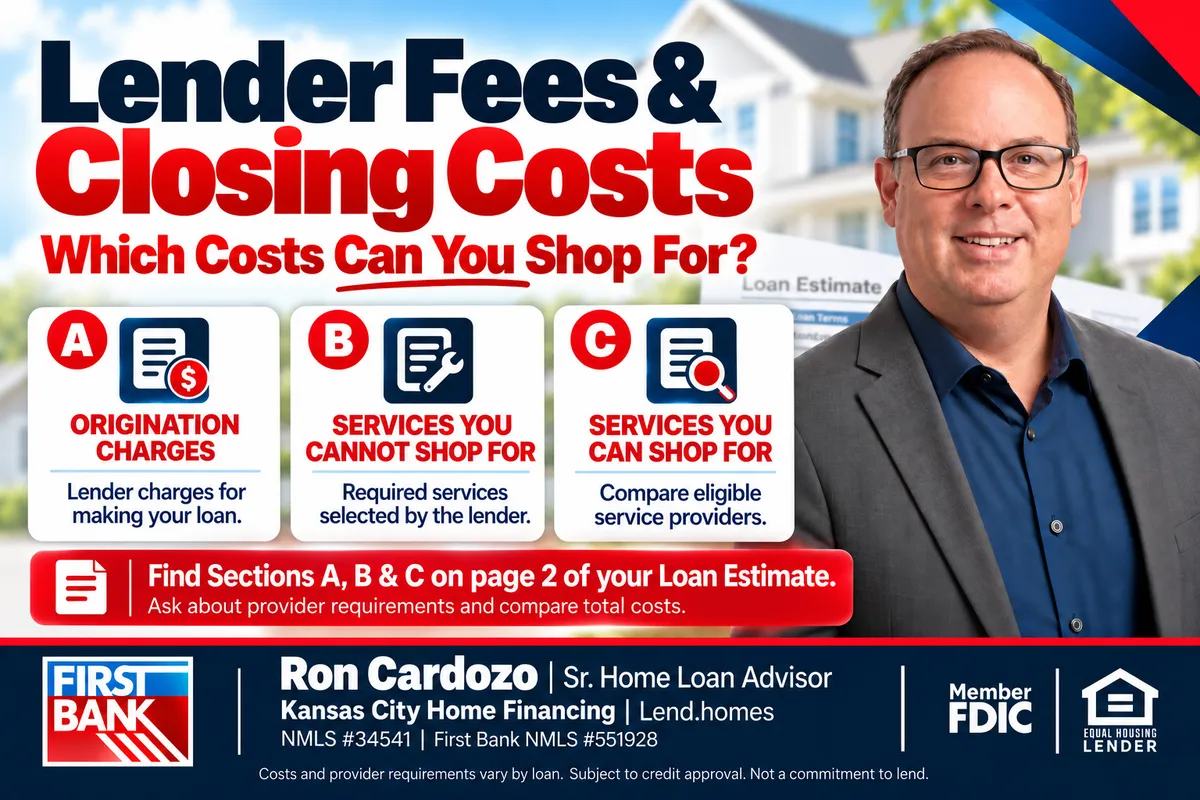
What Are All of Your Lender Fees, and Which Closing Costs Can I Shop for Myself?

By Ron Cardozo, Sr. Home Loan Advisor | First Bank Mortgage | NMLS #34541
When most people shop for a mortgage, they focus on one number: the interest rate. But the rate is only part of what you pay. Every loan also comes with closing costs, and those costs can vary quite a bit from one lender to the next.
Some of those costs are lender fees, like origination, underwriting and processing. Others are third-party services, like title, settlement and surveys. And here's what many buyers don't realize: for some of those third-party services, you get to choose the provider yourself.
That's why two of the best questions you can ask any lender are: "What are all of your lender fees?" and "Which closing costs can I shop for myself?"
In this post, I'll walk you through exactly where to find each type of cost on your Loan Estimate, what you can and can't shop for, and how to compare lenders the smart way.
Lender Fees: What's in Section A
Your official Loan Estimate breaks closing costs into lettered sections on page 2. The fees your lender charges for making your loan show up in Section A, Origination Charges.
According to the CFPB, an origination fee is what the lender charges for making the loan, and origination services can include processing your application, underwriting and funding the loan, and other administrative work. Depending on the lender, you might see these itemized as:
- Origination fee: the lender's charge for creating your loan
- Underwriting fee: for reviewing and approving your file
- Processing fee: for gathering and verifying your documents
- Application, administrative or other lender fees: names vary by lender
- Discount points: if you choose to pay them to lower your rate (shown as a percentage of the loan amount)
Here's the key: it's the total that matters, not the labels. One lender might show a single origination fee, while another breaks the same cost into three smaller fees. Compare the Section A totals side by side.
Good news: Section A fees are generally locked in once you receive your Loan Estimate. Under federal rules, fees paid to the lender, a mortgage broker or their affiliates generally can't increase at closing unless there's a valid change in circumstances, such as a change to your loan amount, program or property.
Third-Party Services: What You Can and Can't Shop For
Not every closing cost goes to your lender. Many are paid to outside companies that provide services your lender requires. The Loan Estimate splits these into two groups.
Section B: Services You Cannot Shop For
These are required services where the lender chooses the provider. Common examples include:
- Appraisal fee
- Credit report fee
- Flood determination fee
- Tax service or similar verification fees
You can't pick a different company for these, which is why they matter when you compare lenders.
Section C: Services You Can Shop For
These are required services where you're allowed to choose the provider, as long as they meet reasonable requirements like proper licensing. Common examples include:
- Title search and lender's title insurance
- Settlement or closing agent fee
- Survey fee
- Pest inspection fee
When you're allowed to shop, your lender must give you a written list of providers within three business days of your application. That list names at least one company for each service and states that you can choose a different one.
| Section A | Section B | Section C | |
|---|---|---|---|
| What it is | Lender's own fees | Required third-party services | Required third-party services |
| Who picks the provider | Lender | Lender | You can |
| Examples | Origination, underwriting, processing, points | Appraisal, credit report, flood certification | Title, settlement agent, survey, pest inspection |
| Can you shop it? | Compare lenders | Compare lenders | Yes, shop providers |
A CFPB tip worth knowing: when comparing Loan Estimates from different lenders, concentrate on Sections A and B. You can shop for the Section C services no matter which lender you pick.
Other Closing Costs and the Rules That Protect You
The rest of page 2 covers Other Costs, which aren't lender fees but still affect your cash to close:
- Section E, Taxes and Other Government Fees: recording fees and any transfer taxes
- Section F, Prepaids: homeowner's insurance premium, prepaid interest and sometimes property taxes
- Section G, Initial Escrow Payment: money set aside to start your escrow account for taxes and insurance
- Section H, Other: items like an owner's title policy, HOA fees or home warranty, if applicable
Homeowner's insurance is another cost you can shop for. You can compare premiums and coverage from different insurance companies to find the best fit.
How much can your costs change before closing?
The CFPB explains that closing costs fall into three groups when it comes to increases:
| Can't increase at all* | Can increase up to 10% in total* | Can change by any amount |
|---|---|---|
| Fees paid to the lender, broker or their affiliates | Recording fees | Prepaid interest, insurance premiums and escrow deposits |
| Required services you weren't allowed to shop for (from an unaffiliated provider) | Section C services when you pick a provider from the lender's written list | Section C services when you pick a provider not on the lender's list |
| Transfer taxes | Third-party services the lender doesn't require |
*Unless there's a valid "change in circumstances," such as a change in your loan amount, loan program or property.
This is an important trade-off to understand. Choosing your own provider can save you money, but if they aren't on your lender's list, that cost isn't protected by the 10% limit. Get a written quote from any provider you choose.
How to Compare Lenders and Shop Smart
Here's a simple game plan:
- Get official Loan Estimates from each lender you're considering, ideally on the same day and for the same loan type, so the comparison is fair.
- Compare Section A side by side. This is where lender fees really differ. Look at the total, not the fee names.
- Check Section B. These costs can also vary by lender, since the lender chooses the provider.
- Look at points and lender credits. Make sure each quote has the same number of points or credits, or you're comparing apples to oranges.
- Review the written list of providers for Section C, then decide whether to use a listed company or shop on your own.
- Shop your homeowner's insurance with a few agents for the best combination of price and coverage.
Questions to ask any lender
- "What are all of your lender fees, and what does each one cover?"
- "Which services can I shop for, and can I see your written list of providers?"
- "Are any of the providers on your list affiliated with you?"
- "Is this quote with points, lender credits, or neither?"
- "What could cause any of these costs to change before closing?"
A good lender will answer every one of these clearly. If you get vague answers or pressure to commit before you see a Loan Estimate, that's a red flag.
On a purchase, your real estate agent may also have recommendations for title and settlement companies they trust here in the Kansas City area and at the Lake of the Ozarks. Just remember, the choice is yours.
Frequently Asked Questions
Do I have to give a lender my pay stubs to get a Loan Estimate?
No. According to the CFPB, a lender can't require documents as a condition of giving you a Loan Estimate. They need just six pieces of information, including your name, income, Social Security number, property address, estimated property value and loan amount.
Are lender fees negotiable?
Sometimes. Fees vary between lenders, and it's always fair to ask what each fee covers. Comparing official Loan Estimates is the best way to see where you stand.
Is a "no closing cost" loan really free?
Not exactly. Those costs are usually covered by lender credits in exchange for a higher interest rate, or added to your loan amount. It can still be a good fit, but you'll pay for it in another way.
Do I have to use the title company my lender lists?
No. If title services appear in Section C, you can choose another qualified provider. Just keep in mind that a provider not on your lender's list isn't covered by the 10% limit on increases.
Can the seller help pay my closing costs?
Often, yes, through seller concessions negotiated in your purchase contract. Each loan program has limits on how much a seller can contribute.
When will I see my final costs?
You'll receive your Closing Disclosure at least three business days before closing. Compare it line by line with your Loan Estimate, and ask me about anything that changed.
No Surprises, Just Straight Answers
You deserve to know exactly what you're paying and why. When you work with me, I'll walk you through every line of your Loan Estimate, explain each lender fee, show you which services you can shop for, and help you compare your options with confidence.
📲 Want a full breakdown of your closing costs? Call or text me, and let's go through it together.

Ron Cardozo | Sr. Home Loan Advisor
📞 Call/Text: 913-710-5626
📧 Email: [email protected]
🌐 Web: www.RonCardozo.com
🏡 www.Lend.homes | Your Lender for Life
About Ron: Ron Cardozo has helped homebuyers and homeowners since 1998 and is a Five Star Mortgage Professional. Based in Overland Park, Kansas, Ron serves the Kansas City metro and the Lake of the Ozarks, helping clients with purchase, refinance, first-time buyer, VA, FHA, USDA, jumbo and second-home financing.
First Bank Mortgage | NMLS #34541 | First Bank NMLS #551928 | Equal Housing Lender. This article is for general educational purposes only and is not a commitment to lend or an offer of credit. All loans are subject to credit approval, underwriting guidelines and property eligibility. Fees, closing costs and program terms vary by loan and are subject to change. Your actual costs will be shown on your official Loan Estimate. Not all borrowers will qualify.
Sources
- CFPB: Can my final mortgage costs increase from what was on my Loan Estimate?
- CFPB: What are mortgage origination services? What is an origination fee?
- CFPB: Your Home Loan Toolkit
- CFPB: Guide to the Loan Estimate and Closing Disclosure forms
- CFPB: TILA-RESPA Integrated Disclosure Rule Small Entity Compliance Guide


