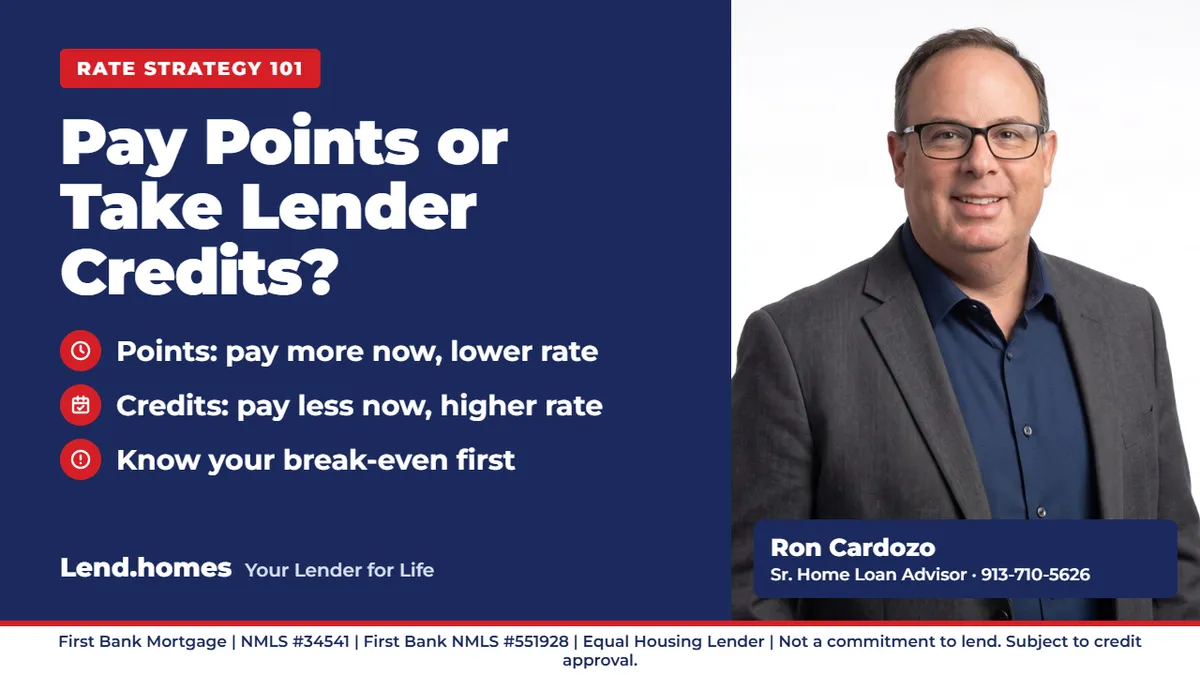
Should I Pay Points to Lower My Rate, or Take Lender Credits to Lower My Closing Costs?

By Ron Cardozo, Sr. Home Loan Advisor | First Bank Mortgage | NMLS #34541
When you look at a mortgage quote, the interest rate isn't a fixed number carved in stone. For almost every loan, you get a menu: you can pay a little more at closing to get a lower rate, take a slightly higher rate in exchange for help with your closing costs, or land right in the middle.
That's the choice between discount points and lender credits, and it's one of the most misunderstood decisions in the whole home loan process.
Here's the short answer: paying points costs more upfront but can save you money every month, so the right choice depends on how long you plan to keep the loan. Keep it a long time, and points may pay off. Sell or refinance in a few years, and you may never earn that money back.
Let's walk through how it works, how to run the math yourself, and which option tends to fit which kind of buyer.
Points vs. Lender Credits: What's the Difference?
The Consumer Financial Protection Bureau (CFPB) describes points and lender credits as two sides of the same trade-off in how you pay for your mortgage and your closing costs.
Discount points are an upfront charge you pay at closing in exchange for a lower interest rate.
- One point equals 1% of your loan amount. On a $300,000 loan, one point is $3,000.
- Points don't have to be whole numbers. You might see half a point, three-eighths of a point, or another fraction.
- A lower rate means a lower monthly principal and interest payment for as long as you keep the loan.
Lender credits work the same way in reverse. You accept a slightly higher interest rate, and the lender gives you money to put toward your closing costs.
- Lender credits are sometimes called "negative points" on a pricing worksheet.
- They lower the cash you need at closing, but your monthly payment is higher because the rate is higher.
The "par" option sits in the middle: no points paid and no credits received. It's often the easiest way to compare offers side by side.
| Pay Points | Par (Neither) | Take Lender Credits | |
|---|---|---|---|
| Cash at closing | Higher | Standard | Lower |
| Interest rate | Lower | Market rate | Higher |
| Monthly payment | Lower | Standard | Higher |
| Usually fits best when… | You'll keep the loan a long time | You want simplicity | You'll move or refinance sooner, or need to conserve cash |
One important note: how much a point actually lowers your rate isn't set in stone. According to the CFPB, it depends on the lender, the type of loan, and market conditions on the day you lock. That's why the math in the next section matters so much.
The Break-Even Test: The One Calculation That Decides It
Paying points only saves you money if you keep the loan long enough for your monthly savings to add up to more than what you paid. The CFPB has noted that most borrowers only benefit from discount points if they keep the mortgage that long. The point where you get your money back is your break-even point.
Here's the simple formula:
Cost of the points ÷ Monthly payment savings = Months to break even
For example, if the points cost 40 times what they save you each month, your break-even is 40 months, a little over three years.
- Plan to keep the loan well past the break-even? Points may be worth it. Every month after that point is money back in your pocket.
- Might sell, move, or refinance before you hit it? You'd likely be better off skipping points, or even taking a lender credit.
The same logic runs in reverse for lender credits. You get cash today, but you pay a higher payment every month. If you keep the loan a long time, that higher payment eventually adds up to more than the credit you received.
Questions to ask yourself before you decide
- How long do I realistically expect to live in this home? Think about job changes, a growing family, or a move-up purchase.
- Is there a chance I'll refinance? If rates drop meaningfully, a refinance resets the clock and the money you spent on points doesn't come with you.
- Where is my cash better spent? Money spent on points can't go toward your down payment, reserves, moving costs, or furnishing your new home.
- Does a lower payment help me qualify or feel comfortable? Sometimes a lower payment matters for your monthly budget, not just the long-term math.
I'll run your break-even for you using your actual Loan Estimate figures, so you're comparing real numbers, not guesses.
Which Option Fits You?
There's no one-size-fits-all answer, but here's how it often shakes out for the buyers and homeowners I work with across Kansas City and the Lake of the Ozarks.
Paying points may make sense if you:
- Plan to stay in the home for many years (your "forever home" or a long-term second home)
- Have extra cash after your down payment and reserves
- Don't expect to refinance any time soon
- Want the lowest possible monthly payment over the long haul
Taking lender credits may make sense if you:
- Expect to move, upgrade, or relocate within a few years
- Want to keep more cash in the bank at closing, especially as a first-time buyer
- Think there's a good chance you'll refinance if rates come down
- Need help covering closing costs and are comfortable with a slightly higher payment
Staying at par may make sense if you:
- Aren't sure how long you'll keep the loan
- Want the cleanest, simplest comparison between lenders
- Would rather keep your options open
Don't forget about seller concessions
On a purchase, lender credits aren't the only way to reduce your cash to close. Depending on the loan program and the deal, a seller may agree to contribute toward your closing costs, and in some cases those funds can even be used to buy down your rate. Each loan program has its own limits on seller contributions, so talk with me and your real estate agent before you write the offer.
Where to Find Points and Credits on Your Loan Estimate
You don't have to take anyone's word for what you're paying. It's all spelled out on your official Loan Estimate, and later on your Closing Disclosure:
- Points show up on page 2, Section A (Origination Charges). By law, points listed there must be tied to a discounted interest rate.
- Lender credits show up on page 2, Section J, as a negative number that reduces your closing costs.
Smart questions to ask any lender
- "What's my rate and cost at par, with no points and no credits?"
- "How much would it cost to lower my rate, and by how much would it drop?"
- "How much in lender credits could I get, and how much higher would my rate be?"
- "What's my break-even on each option?"
The CFPB recommends that when you compare lenders, you ask each one for the same number of points or credits, and ask to see two versions of the offer: one with points or credits and one without. Otherwise, you could end up comparing apples to oranges.
Frequently Asked Questions
Is paying points always a good deal?
No. Points only pay off if you keep the loan past your break-even point. The CFPB has cautioned that points don't always save borrowers money, so it's worth running the numbers before you commit.
Are "points" and "origination fees" the same thing?
Not necessarily. Some lenders use the word "points" for any fee calculated as a percentage of the loan, even if it doesn't lower your rate. Discount points are specifically tied to a lower interest rate. Always ask what each fee buys you.
Can the seller pay for my points?
Often, yes. On a purchase, seller concessions can sometimes be used to buy down your rate, within the limits of your loan program. Let's talk before you write your offer.
What if I pay points and then rates drop?
If you refinance before reaching your break-even, you won't recover the full cost of those points. If you think a refinance is likely, that's a strong reason to consider par or lender credits instead.
Are points tax deductible?
In some cases, mortgage points may be deductible. Rules vary based on your situation, so please check with your tax professional. I'm not able to give tax advice.
Can I change my mind after I lock?
Your points or credits are generally set as part of your rate lock. Changes after locking may affect your pricing, so it's best to decide before you lock. We'll walk through your options together first.
Let's Run Your Numbers Together
Points, credits, or par: the right answer depends on your plans, your cash, and your timeline. My job isn't just to quote you a rate. It's to show you every option side by side, calculate your break-even, and help you pick the one that fits your life and your financial goals.
📲 Want to see your points vs. credits options? Call or text me, and I'll walk you through it.

Ron Cardozo | Sr. Home Loan Advisor
📞 Call/Text: 913-710-5626
📧 Email: [email protected]
🌐 Web: www.RonCardozo.com
🏡 www.Lend.homes | Your Lender for Life
About Ron: Ron Cardozo has helped homebuyers and homeowners since 1998 and is a Five Star Mortgage Professional. Based in Overland Park, Kansas, Ron serves the Kansas City metro and the Lake of the Ozarks, helping clients with purchase, refinance, first-time buyer, VA, FHA, USDA, jumbo and second-home financing.
First Bank Mortgage | NMLS #34541 | First Bank NMLS #551928 | Equal Housing Lender. This article is for general educational purposes only and is not a commitment to lend or an offer of credit. All loans are subject to credit approval, underwriting guidelines and property eligibility. Rates, points, lender credits and program terms are subject to change without notice. The amount a discount point lowers an interest rate varies by loan type and market conditions. Consult a tax advisor regarding the deductibility of points. Not all borrowers will qualify.


