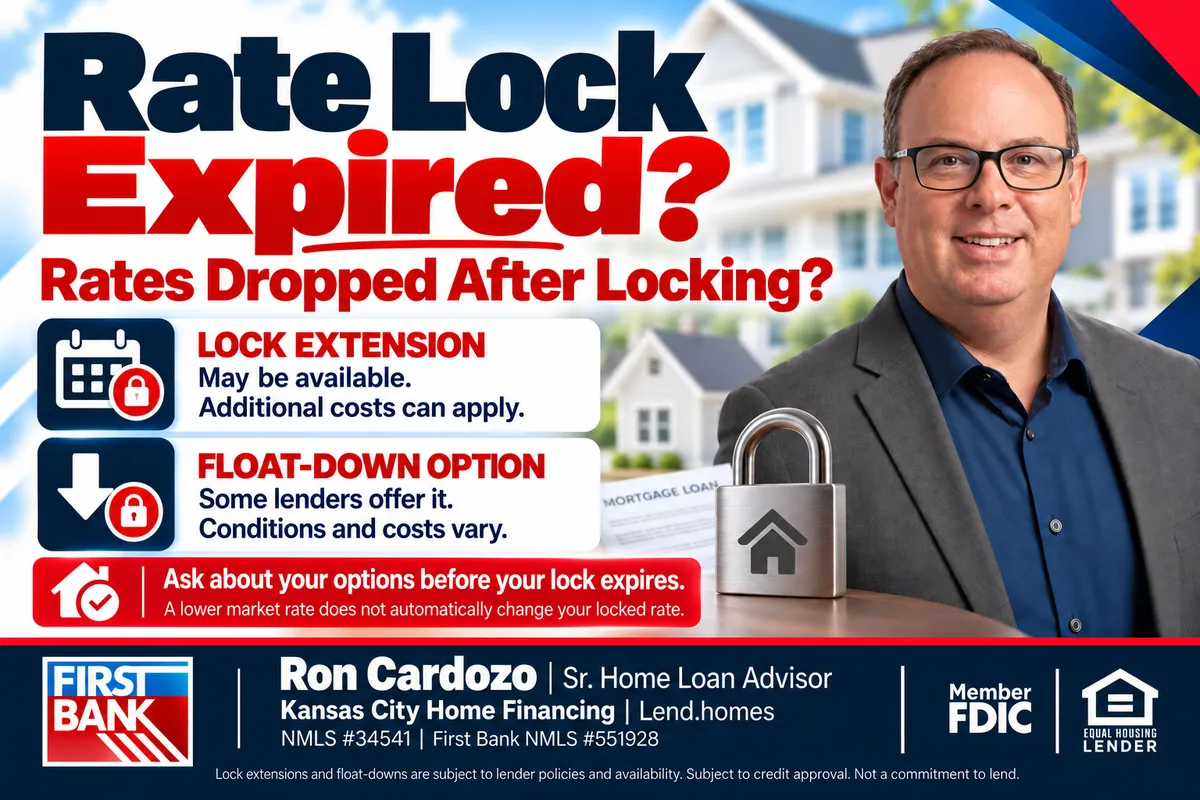
What Happens If My Rate Lock Expires, or Rates Drop After I Lock?

By Ron Cardozo, Sr. Home Loan Advisor, First Bank Mortgage | Overland Park, KS
Locking your rate gives you peace of mind. But two things can still catch buyers off guard:
- Your closing gets delayed and the lock expires.
- Rates drop after you've already locked.
The CFPB points out both downsides: a lock can be expensive to extend, and it can lock you out of a lower rate if rates fall. Some lenders offer a "float-down" option for that second situation, but not all do, and the details vary.
Here's what happens in each case and how to protect yourself.
If Your Rate Lock Expires
A rate lock only holds your rate if you close within the lock period. According to the CFPB, even a locked rate can change if you don't close within the rate-lock timeframe.
If your closing is delayed, by an appraisal, title issue, repairs or underwriting, you typically have a few options, depending on your lender:
| Option | How it works | What to watch for |
|---|---|---|
| Extend the lock | The lender holds your rate for extra days | Extensions often come with a fee or a slightly higher rate |
| Relock at today's rates | Your rate is repriced at current market rates | Better if rates have fallen, costly if they've risen |
| Lock longer from the start | Choose a longer lock period up front when you expect delays | May cost a bit more, but can be cheaper than paying to extend later |
Ask who pays when the delay isn't your fault. Some lenders absorb extension costs when they caused the delay. Find out your lender's policy before you lock.
If Rates Drop After You Lock
A lock works both ways. It protects you if rates rise, but you typically keep your locked rate if rates fall. The CFPB notes a lock may lock you out of a lower rate.
What's a float-down? A float-down is an option some lenders offer that lets you take a lower rate if market rates fall enough after you lock. It isn't standard, and when it's available it usually comes with conditions, such as:
- Rates must drop by a minimum amount
- It may only be used once, within a certain window before closing
- It may carry a fee or be built into your pricing
If a lender doesn't offer a float-down, switching lenders late in the process to chase a lower rate can mean new fees, a new appraisal and a delayed closing, so the savings need to be worth it.
The best approach is to ask about float-down options before you lock, so you know exactly what you can and can't do if the market moves.
How to Avoid Rate Lock Problems
- Pick a lock period that covers your closing date, with a cushion for delays.
- Respond quickly to document requests so underwriting stays on schedule.
- Schedule your inspection and appraisal early.
- Keep your finances steady. Changes to your credit, income, loan amount or down payment can change even a locked rate.
- Stay in touch with your lender and agent so everyone knows right away if the timeline slips.
- Ask about extension and float-down policies up front, before you need them.
Questions to Ask Your Lender
The CFPB suggests asking these before you lock:
- What happens if I can't close in time?
- Is there a fee to extend the lock, and how much is it?
- Is there a chance you'd refuse to extend the lock?
- Are other lock periods available, and how would my pricing change?
- If I lock and rates go down, what happens?
And two more worth adding:
- Do you offer a float-down, and what are the conditions and cost?
- Who pays for an extension if the delay is on the lender's side?
Frequently Asked Questions
Will my rate automatically go up if my lock expires?
Not automatically, but it can. Without an extension, your rate may be repriced at current market rates, which could be higher or lower.
How much does a lock extension cost?
It varies by lender and by how many extra days you need. Your Loan Estimate won't show it, so ask up front.
Is a float-down the same as relocking?
Not exactly. A float-down is a specific option some lenders offer to lower a locked rate under certain conditions. Relocking usually means repricing your loan at current rates, often after a lock expires.
Can I switch lenders if rates drop after I lock?
You can, but it may mean new fees, a new application and appraisal, and a delayed closing. Compare the total savings to the costs and timing risk first.
Does a delay always mean I'll pay more?
No. Planning a lock period with a cushion, and knowing your lender's extension policy, can help you avoid extra costs.
Know Your Options Before You Lock
I'll walk you through lock periods, extension costs and any float-down options up front, and I'll keep your closing on track so your lock covers it. No surprises at the finish line.
Have questions about rate locks, extensions or float-downs? Call or text me.

Ron Cardozo | Sr. Home Loan Advisor
Call/Text: 913-710-5626
Email: [email protected]
Web: www.RonCardozo.com
Lend.homes: www.Lend.homes
About Ron: I've helped homebuyers in the mortgage industry since 1998 and am a Five Star Mortgage Professional award recipient. I serve the Kansas City metro on both sides of State Line and the Lake of the Ozarks, with an office at 6201 College Blvd, Suite 100, Overland Park, KS 66211. Lend.homes, Your Lender for Life.
First Bank Mortgage | NMLS #34541 | First Bank NMLS #551928 | Equal Housing Lender. This article is for general educational purposes only and is not a commitment to lend, an offer of credit or a rate quote. All loans are subject to credit approval, underwriting guidelines and property eligibility. Interest rates change daily and are not guaranteed until locked. Rate lock periods, extension fees and float-down availability vary by lender and loan program and may change without notice. Not all borrowers will qualify.
Sources: CFPB: What's a lock-in or a rate lock? · CFPB: Can my final mortgage costs increase? · CFPB: Review your Loan Estimates


