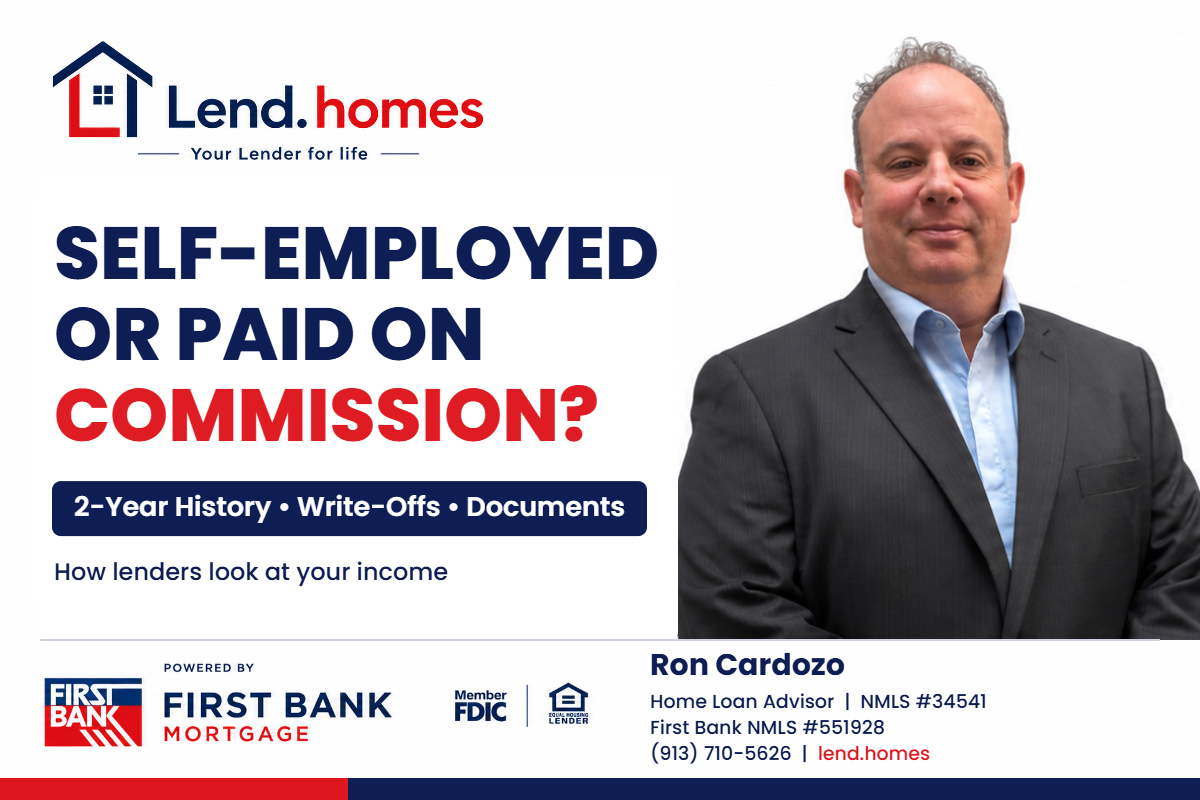
Self-Employed or Paid on Commission? How Lenders Look at Your Income
By Ron Cardozo, Senior Home Loan Advisor, First Bank Mortgage | Lend.homes, Your Lender for Life
Business owners, independent contractors, real estate agents and commissioned salespeople often earn great money. But when it's time to get a mortgage, they hear, "Your income is harder to document."
It's not harder to qualify. It's different. Here's how lenders look at it, and how to set yourself up for a smooth approval.
The short version: lenders usually average your income over the last two years, using what's on your tax returns after expenses. The write-offs that lower your taxes can also lower your qualifying income, so plan ahead.
Who Counts as Self-Employed?
Lenders generally consider you self-employed if you own 25% or more of a business, or if you're paid on a 1099 instead of a W-2. That includes:
- Sole proprietors and freelancers
- Owners of LLCs, partnerships and S corporations
- 1099 contractors, including many real estate agents and gig workers
If you're a W-2 employee paid mostly on commission or bonus, you're not self-employed, but lenders still look closely at how consistent that income is.
The Two-Year Rule
Most programs want to see about two years of self-employment or commission history. The lender averages your income over that period to get a stable monthly number.
- Income going up? The lender usually averages the two years.
- Income going down? The lender may use the lower, most recent year, and may ask why it dropped.
- Less than two years? Some programs allow it if you were in the same line of work before, often as an employee.
Why Write-Offs Matter
Lenders qualify you on your net income: what's left after business expenses. If your business grossed a large amount but your tax return shows a much smaller profit, the smaller number is usually what counts.
Some expenses can be added back, such as depreciation and certain one-time costs. That's why having a lender who knows how to read business returns makes a real difference.
Documents to Have Ready
- Two years of personal federal tax returns, with all schedules
- Two years of business returns (1120S, 1065 or 1120), if applicable
- K-1s for any partnerships or S corporations
- A year-to-date profit and loss statement, if requested
- Recent business and personal bank statements
- A business license or CPA letter, if requested
- For commission earners: recent pay stubs and two years of W-2s
How to Prepare a Year Ahead
- Talk to your CPA and your lender together. Balance tax savings against the income you'll need to qualify.
- File your returns on time. Extensions can delay a purchase.
- Keep business and personal money separate. Clean statements are easier to review.
- Avoid big swings. A sudden drop in profit can raise questions.
- Document cash for closing. Using business funds may require extra steps.
Frequently Asked Questions
Can I use my business account for my down payment?
Often yes, with documentation showing that removing the money won't hurt the business.
I just went from W-2 to 1099 in the same field. Can I still buy?
Possibly. Your prior experience can sometimes count. Let's look at your history.
Do bank portfolio loans help self-employed buyers?
Sometimes. Portfolio loans may allow more flexibility in certain situations. Ask me if one fits.
Want to see how your income and debts work together? Read Mastering Your DTI Ratio.
 | Business Owner? Let's Review Your ReturnsSend me your last two years of returns and I'll show you how a lender will calculate your income, before you shop. Ron Cardozo, Senior Home Loan Advisor |
 |  |
Important information: This article is for general educational purposes only and is not a loan offer, rate quote, or commitment to lend. It is not tax advice; consult your CPA or tax professional. Income calculation methods and documentation requirements vary by loan program and individual circumstances. Final loan approval is subject to credit approval, underwriting guidelines, verification of income and assets, appraisal, title, and property eligibility. Program availability, terms, and eligibility requirements vary and may change without notice. Not all applicants will qualify.
Ron Cardozo, NMLS #34541. First Bank Mortgage, NMLS #551928. 6201 College Blvd, Suite 100, Overland Park, KS 66211. Member FDIC. Equal Housing Lender.


